
Blog / Maths
100 Chart Activities: Unlocking Patterns & Play
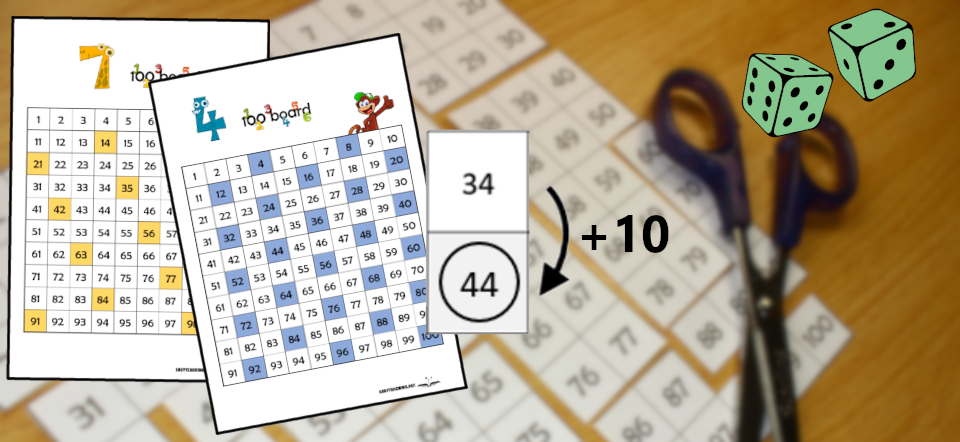



So much more than just a grid of numbers, a hundred chart is packed with potential for teaching a variety of mathematical concepts. Read along as we explore 9 engaging 100 chart activities to use in the classroom and at home. If it’s not already, the hundred number board is about to become your new best friend in math class
Benefits of Using Hundred Charts
This simple, yet incredibly effective teaching tool is a true jack of all trades in a maths classroom. From helping students grasp place value to making patterns and sequences come alive, a hundred chart activities offer a visual and interactive way to understand numbers. Hundred charts are particularly helpful when teaching or learning:
- Adding/subtracting multiples of 10
- Identifying number patterns
- Skip counting
- Repeated addition
Fun 100 Chart Activities & Games
Guess My Number
The teacher chooses a secret number between 0 and 100. Students take turns asking yes/no questions to guess the number. For example, “Is your number greater than 50?” Students use the hundred chart to help guess the number as each question helps narrow down the possibilities. A class chart can be used, or individual charts on which students can cross off numbers. This game helps develop problem-solving skills and place value understanding.
Pattern Detectives
How to Play: Create a pattern on the chart (e.g., 2, 4, 6, 8). Ask children to figure out the rule and continue the pattern. Interactive 100 charts are great for this.
Colour by Number
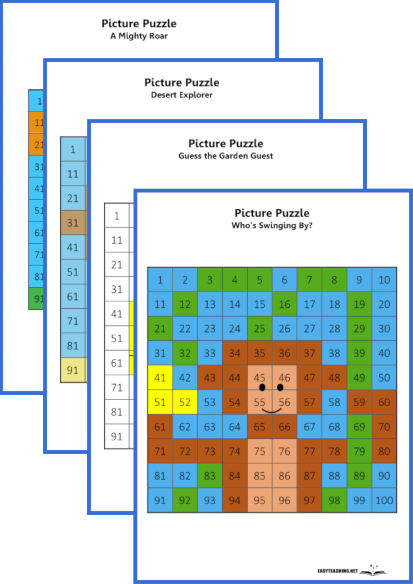
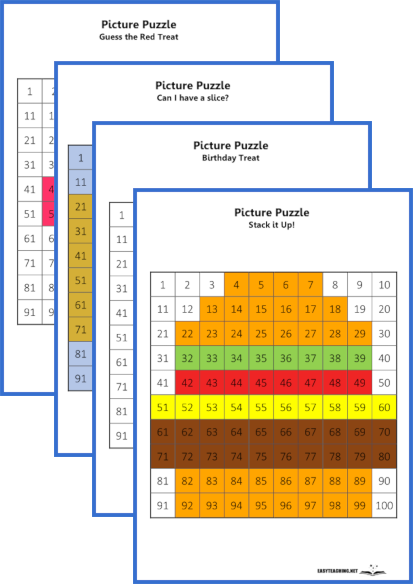
Practice number recognition and fine motor skills with mystery images.
Mystery Number
Choose a ‘mystery number’ and give a series of clues to help them guess what it is. For example:
Both digits are even.
The tens digit is 4.
The digit in the ones place is greater than the digits in the tens place.
Give children individual hundred charts to use to help them work out what the number could be. This hundred chart activity is great for reinforcing critical thinking and deduction skills.
Skip Counting
Place counters on the hundred chart to show counting patterns. This allows students to see a visual representation of numbers in sequence and helps visual learners understand the concept of skip counting. This is also a great hundred chart activity to prepare students to understand explore the concept of multiplication as repeated addition.
Times Tables
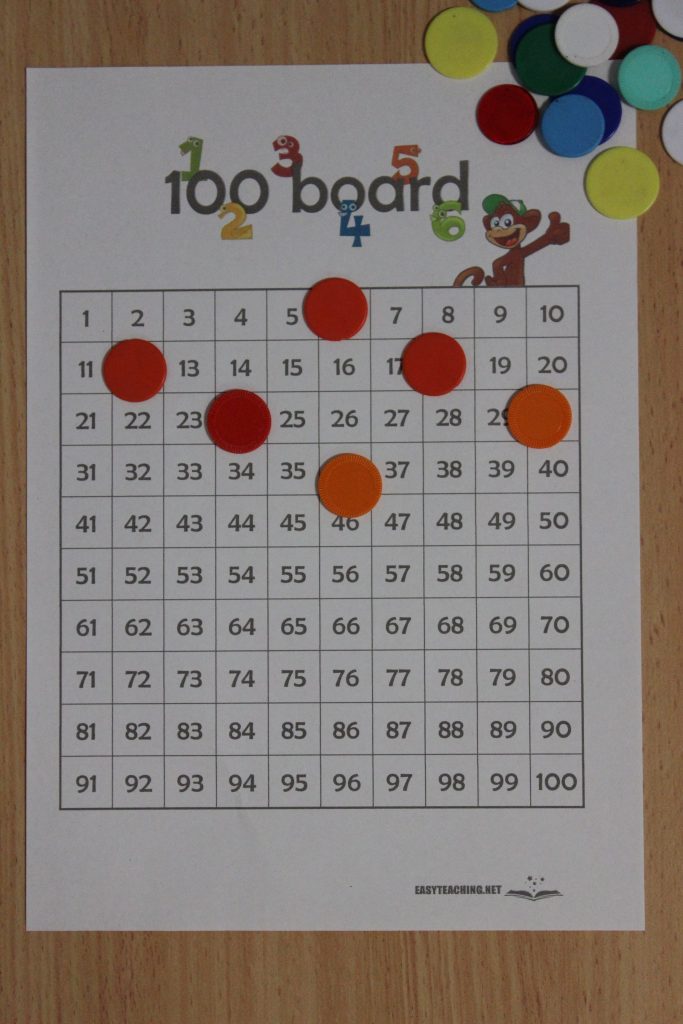
Place counters on the hundred chart that show the multiples of a chosen number. For example, the multiples of 3 would be 6, 12, 18, 24, …
Place counters on the hundred chart to mark the multiples of a chosen number. For example, if the chosen number is 6, place a counter on every number that is a multiple of 3, such as 6, 12, 18, 24 and so on.
Extend this activity by asking students questions related to the pattern they have demonstrated. For example:
What is the third number in the counting pattern?
If I count to 20, how many times will I pass a counter on the board?
If I count in 6s, what will be the fifth number I come to?
Roll to 100
Print off a hundred board, grab a couple of dice and have students race to the top! Add snakes and ladders for a fun twist!
For an added challenge, race from 100 to 0 and practise subtraction.
Fill in Missing Numbers
These worksheets test students’ understanding of place value and encourage them to practise adding and subtracting 1 and 10 to identify numbers on incomplete hundred charts.


Puzzle Pieces
Cut a hundred chart into pieces and have students put the 100 chart back together! This activity is quick and easy to modify for students of a higher or lower ability. Download a hundred chart and get cutting!
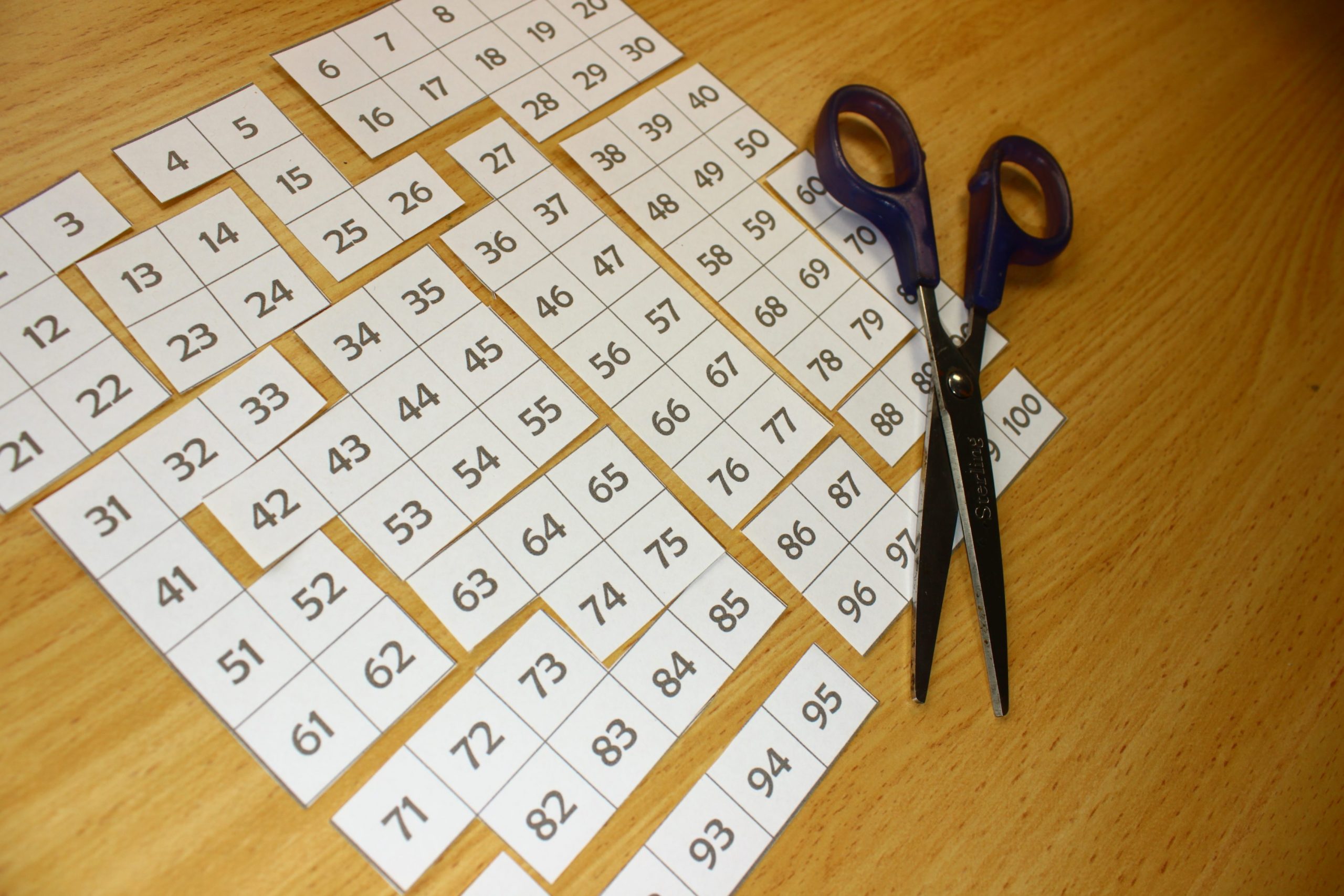
Hundred number boards offer endless possibilities when it comes to practising number concepts. Browse more hundred chart activities here. Whether at home or in the classroom, a hundred chart offers endless opportunities for exploration, inviting children to discover the joy of numbers
Related articles

Patterns to Properties: How to Teach Odd and Even Numbers
Strategies, games and ideas for how to teach odd and even numbers.
Read More
Fun with Place Value: Activities for Early Number Learning
Place value activities to help students understand numbers and build confidence.
Read More
Teaching and Learning Videos
The ways in which students access learning content has expanded. Our YouTube channel aims to make teaching more efficient and learning easier.
Read More

