
TOPICS

Maths
Browse our collection of measurement worksheets and other resources aimed at helping teach students to understand and apply measurement skills. These resources cover topics including reading scales, thermometers, rulers and more.
Use the side menu to search for specific subtopics or use the filter above to narrow the results by resource type and/or grade level.

 Resource Type

 Grade
Grade

 Sort By


Using Area to Design a House

Design a house following specific requirements about the area of different spaces.
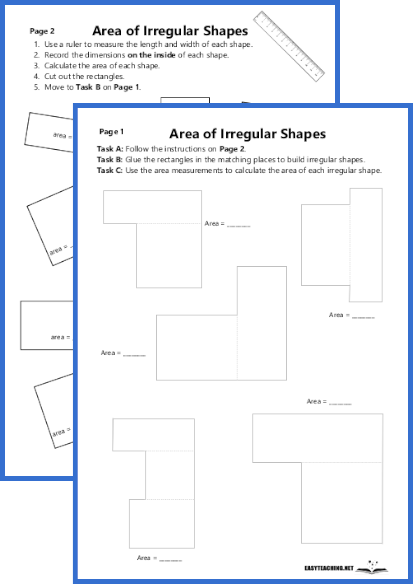
Measure Area of Irregular Shapes Guided
Measure and calculate the area of rectangles. Then use rectangles to calculate area of compound shapes.
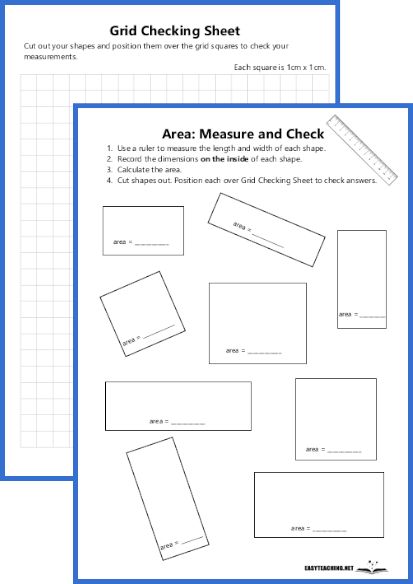
Measure & Check Area (Rectangles)
Use a ruler to measure the length and width of rectangles then calculate the area of each. Check on provided grid paper.

Measure Area of Irregular Shapes
Measure the dimensions of irregular shapes. Calculate the area of each.
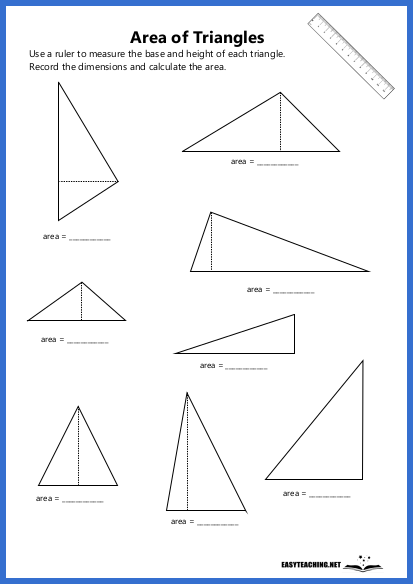
Measure Area (Triangles)
Use a ruler to measure the base and the height of triangles and then calculate the area or each.
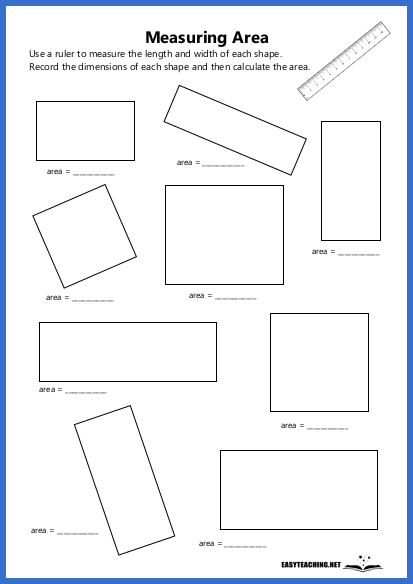
Measure Area (Rectangles)
Use a ruler to measure the length and width of rectangles then calculate the area of each.
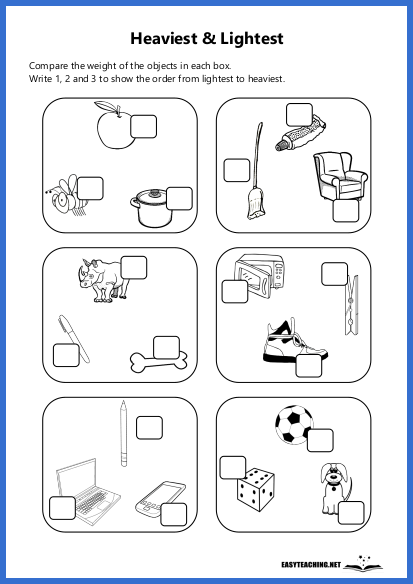
Order Objects by Weight
Order the weight of different objects.
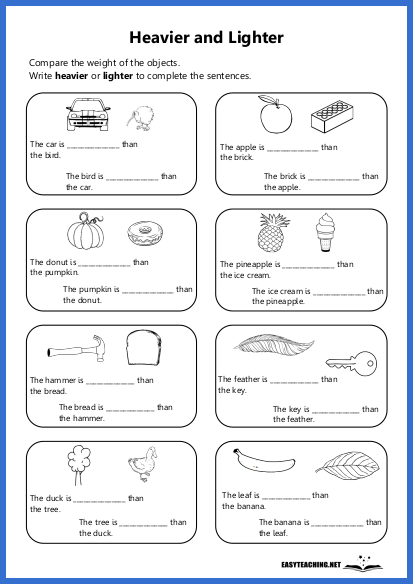
Heavier & Lighter
Use the words ‘heavier’ and ‘lighter’ to complete the sentences.

Which is Heavier?
Identify the heaviest object in each set.
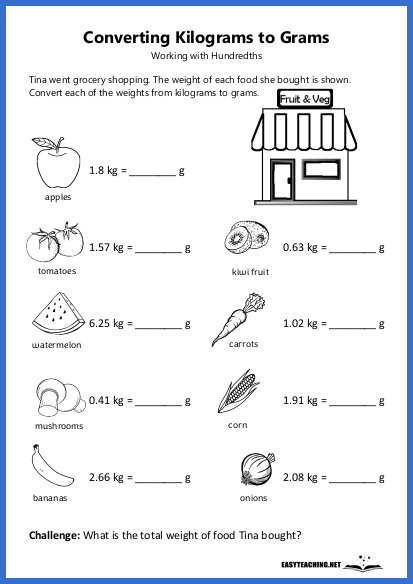
Convert kg to g (Hundredths)
Weights are given in kilograms. Convert them to grams (weights are to hundredths).
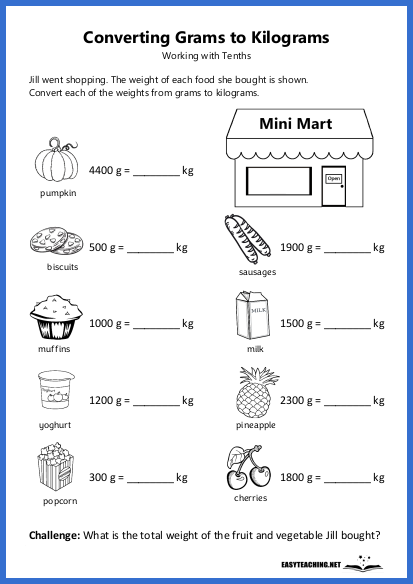
Convert g to kg (Tenths)
Weights are given in grams. Convert them to kilograms (weights are to tenths).
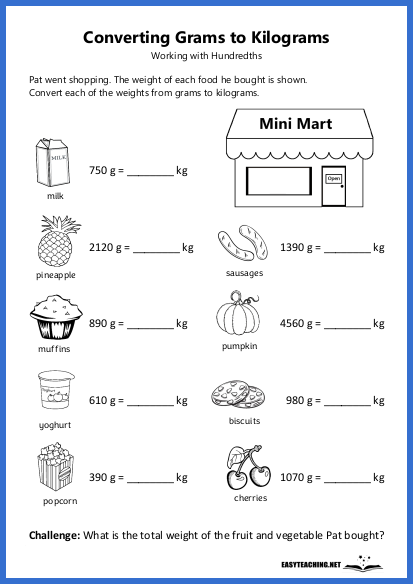
Convert g to kg (Hundredths)
Weights are given in grams. Convert them to kilograms (weights are to hundredths).

Balance Scales Match (2)
Show which objects are heavier by gluing them on the correct sides of the balance scales.

Balance Scales Match (1)
Show which objects are heavier by gluing them on the correct sides of the balance scales.

Using Balance Scales
Use balance scales to compare the weight of pairs of objects. Record the results on the sheet.
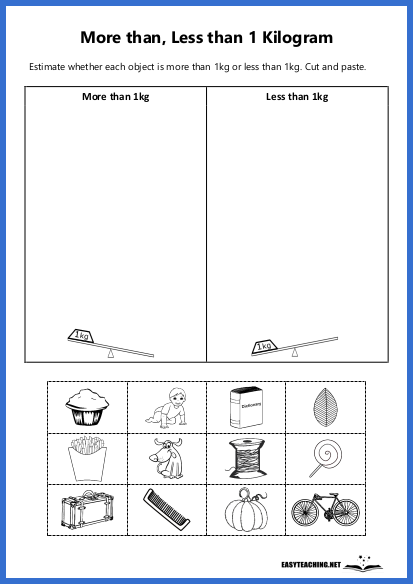
More or Less Than 1kg?
Cut and paste the objects to show whether they are more than or less than 1kg.
EASYTEACHING.NET


