
Capacity

Browse our collection of volume and capacity worksheets and displays. These resources provide students with opportunities to work with litres and millilitres, estimate capacity and volume, read scales and more.

Use the filter above to narrow the results by resource type and/or grade level.

These capacity worksheets include activities where students compare amounts, identify full, empty and half-full containers, and use everyday language to describe capacity. Students also practise estimating and working with units of measurement such as millilitres and litres.

You’ll find worksheets that involve reading scales on containers, ordering different capacities and matching representations to amounts. Some activities use cut and paste tasks and labelled diagrams to support early understanding, while others focus on interpreting measurements more precisely.

The collection includes a mix of hands-on style activities, visual tasks and measurement practice across different levels, making it easier to build confidence with capacity and apply it in practical situations.

Description
Imagen

Volume & Capacity Terms Posters

A set of 5 posters explaining the terms ‘full’, ‘nearly full’, ‘half full’, ‘nearly empty’ and ‘nearly empty’.
Imagen

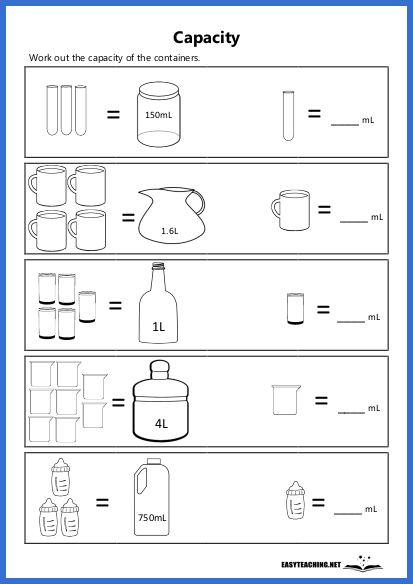
Partitioning Capacity (2)

Partition the capacity of the large containers to calculate the capacity of the smaller containers.

Imagen

Partitioning Capacity (1)

Partition the capacity of the large containers to calculate the capacity of the smaller containers.

Imagen

More or Less Than 1L?

Show whether the containers hold less or more than 1 litre.

Imagen

Volume Match

Read the volume of water in each measuring jug to work out which container it came from.

Imagen

Ordering by Capacity

Cut and paste to sort the containers in order of smallest capacity to largest capacity.

Imagen

Empty, Half Full or Full?

Cut and paste to show whether each container is empty, half full or full.

Imagen

Empty or Full?

Cut and paste to show whether each container is empty or full.

Imagen

Comparing Capacity

Circle the object in each pair that has the greatest capacity.

Imagen

Describing Volume Match

Cut and paste to match the volume terms to the correct containers.

Imagen

Describing Volume

Use volume terms to describe the volume of each container.

Imagen

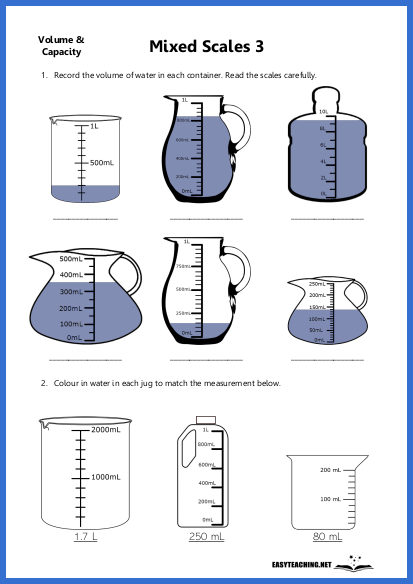
Volume: Mixed Scales (3)

Read the scale and record the volume of each container.

Imagen

Volume: Mixed Scales (2)

Read the scale and record the volume of each container.

Imagen

Volume: Mixed Scales (1)

Read the scale and record the volume of each container.

Imagen

Capacity: Labelled 50mL Increments

Read the scale and record the volume of each container.

Imagen

Capacity: Labelled 100mL Increments (3)

Read the scale and record the capacity of each container.